29 November 2011
weather confuses nature
The terrible storms and ensuing heavy rain have left floods, yet again throughout the Var, the South-East of France and into Italy.
It has also been incredibly mild and I saw these unpruned vines sprouting new leaves :


And I couldn’t resist the colours of the last few leaves and stems of this Parthenocissus tricuspidata


It has also been incredibly mild and I saw these unpruned vines sprouting new leaves :


And I couldn’t resist the colours of the last few leaves and stems of this Parthenocissus tricuspidata


16 December 2010
auprès de mon arbre …
 Another day picking olives yesterday. It was about 3°C but no wind and the sound carried through from the neighbouring olive grove where there were a couple of other people, up ladders and heads among the olives.
One of the pickers sang a beautiful rendition of this Georges Brassens song : Aupès de mon Arbre
(if you would like to see the words, go to YouTube & click on the name of the person who uploaded the video)
 This is always an odd sight : an olive tree (with olives) covered in snow !
You can see more pictures here of last year’s harvest at Celia’s
05 December 2010
saffron
 In May I went to the salon des roses in a nearby wine chateau and I met a saffron (Crocus sativus) grower.
Entranced by the idea of growing my own saffron I bought ten bulbs which I duly planted on 15 August. The leaflet that came with the fat, healthy bulbs said that they would flower over a two week period around the end of October.
By early November we had had very little rain and I kept looking to see if there was any evidence of growth. Sure enough, there were at least ten spiky leaves but no sign of any flowers. Then it rained and within a few days the familiar lilac crocus shape emerged.
Every time I walked past them I checked on their progress – the growers explained that the flower lasts a mere 24 hours and they are up at 04:00 in the morning to pick their precious crop. As it was, my flowers lasted two to three days and because there were so few of them I was able to pick the three red stigmata from each, leaving a rather unseasonally pretty patch of spring-like flowers.
As I write this, there is a very late bloomer, which I will denude before it is dashed to the ground by all the rain. In all, from the ten bulbs I have had 16 flowers. I am planning something special for my 48 strands !

Here is a directory of saffron growers in France.
30 June 2010
crop circles
I came across this YouTube video on crop circles that I wanted to share. Click on the video at the end to see others by the same person.
They’re astonishing …
They’re astonishing …
07 March 2010
Violet Time
I’ve wizzed around some blogs and everyone seems to be wishing Spring was here – Winter has been so long this year for everyone – and talking about almond blossom, which is one of the earliest.
Officially, it’s Spring and we’ve had two false starts – one about three weeks ago and then earlier last week, when it was a balmy 17°C and up to 26°C in the sun. It’s suddenly got really cold again in the last 24 hours with snow flurries this afternoon and the promise of the same tomorrow with a maximum temperature of +1°C !
It has been unusual to see Mimosalia in Bormes-les-Mimosas, Carnival in Nice and the Menton Lemon Festival with everyone wrapped up against the cold. This weekend it was the Fête des Violettes in Tourettes-sur-Loup. I was wondering how they could have flowered in the conditions we have had – I still have a romantic idea that they’re grown in fields …
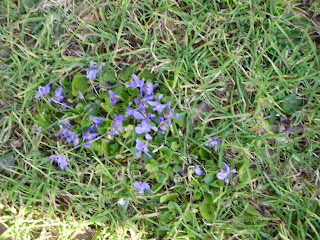
However, at Nicola’s the other day I saw two small patches of violets in one corner of her ‘lawn’ – she had no idea where they had come from. Mine haven’t made an appearance as yet.
Officially, it’s Spring and we’ve had two false starts – one about three weeks ago and then earlier last week, when it was a balmy 17°C and up to 26°C in the sun. It’s suddenly got really cold again in the last 24 hours with snow flurries this afternoon and the promise of the same tomorrow with a maximum temperature of +1°C !
It has been unusual to see Mimosalia in Bormes-les-Mimosas, Carnival in Nice and the Menton Lemon Festival with everyone wrapped up against the cold. This weekend it was the Fête des Violettes in Tourettes-sur-Loup. I was wondering how they could have flowered in the conditions we have had – I still have a romantic idea that they’re grown in fields …

However, at Nicola’s the other day I saw two small patches of violets in one corner of her ‘lawn’ – she had no idea where they had come from. Mine haven’t made an appearance as yet.
07 February 2010
snowdrops
 My RHS magazine arrived today with a picture of snowdrops on the front cover.
A year last autumn I planted ten little snowdrop bulbs, bought from a UK supermarket, as an experiment, in four different places in the garden. It is not, you might think, a plant that you would expect to see in this part of the world, but I love them so much that I thought it was worth a try. I put masses of leaf mould around them in the hope that they wouldn’t dessicate during our blistering summers. They’re planted in our ‘dingly dell’ – a mix of white and evergreen oaks and the ubiqitous pines, that almost grow like weeds here, creating a shady area – a perfect cool spot in the summer.
There are apparently 19 species of Galanthus – and I think mine are possibly G elwesii var. elwesii, as the green marks appear to merge to form an‘X’ and bloom from January to March – and “are native to central and southern Europe and parts of western Asia, where they flourish in cool woodlands and other shady habitats from sea level to around 2,000m (6,500ft). Snowdrops like deep, fertile, well-drained soil, moist in the growing season, but not waterlogged during their summer dormancy.” No chance of that here !
 Last spring, all ten bulbs flowered. I searched and searched for signs of them and suddenly spotted them in two of the four locations – and they have obviously multiplied. A gardening friend who belongs to the MGS said that she had helped someone plant a thousand Spanish bluebells. I wonder …
Subscribe to:
Posts (Atom)





 Posts
Posts